




Dhurandar Mindset: The Power of Compassion, Courage and Inner Strength
March 24, 2026Nothing Beneath: How Nāgārjuna Saved Buddhism by Removing Every Position
April 1, 2026OPEN CAMERA → SCAN TO LIVE THE MIDDLE PATH
The Mindfulness Timer That Calls You Back to Presence
Gentle intervals throughout your day — the most recommended tool for embodying the Middle Way
https://amzn.to/4dtx2U4
Buddhism is one of the world’s oldest and most influential spiritual traditions. Yet it is also one of the most misunderstood. Many people imagine Buddhism only as silent monks meditating in mountain monasteries or as a religion focused purely on inner peace. While meditation and compassion are certainly important, Buddhism also contains one of the richest philosophical traditions in human history.
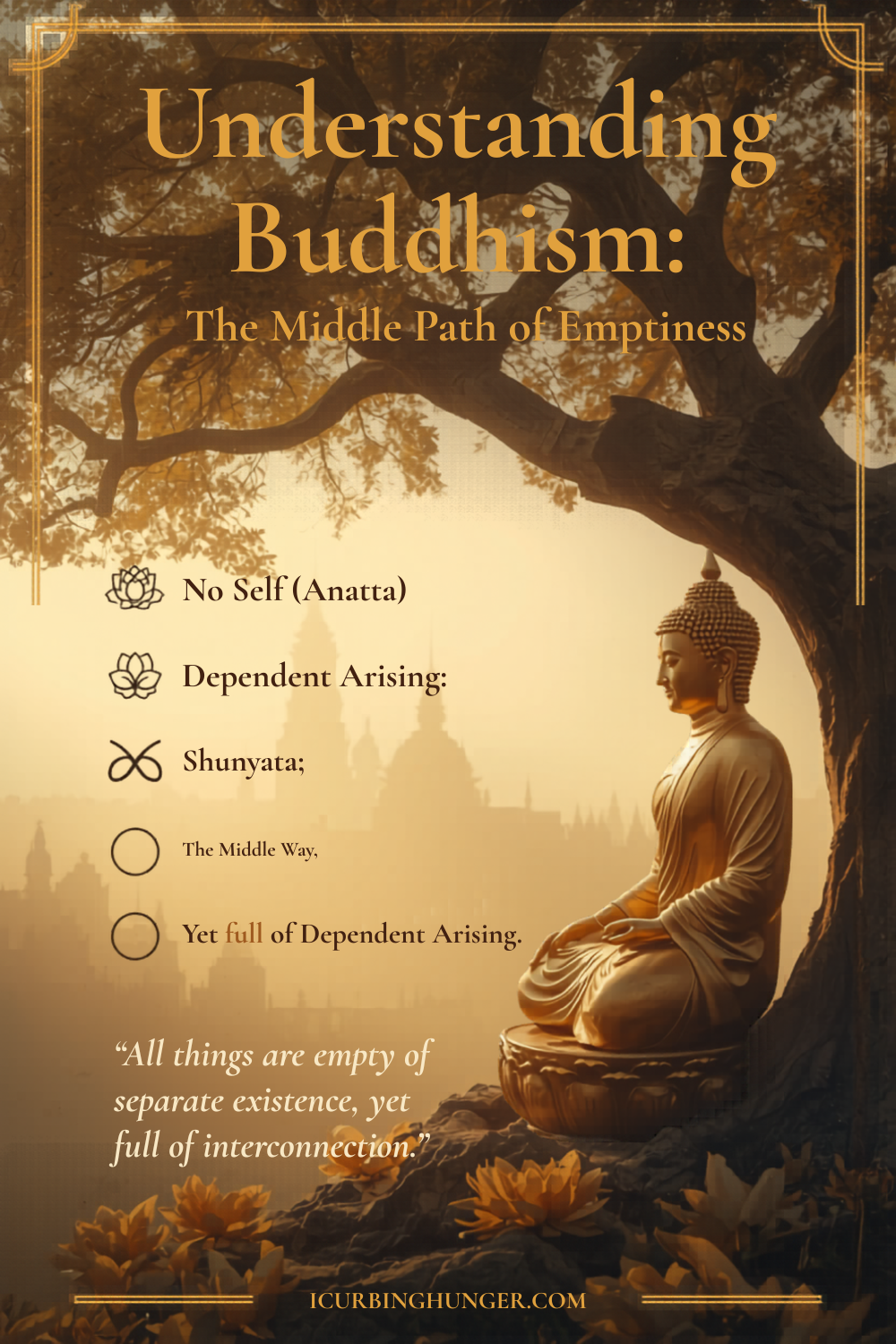
Among the many ideas that Buddhism has contributed to the world, few are as famous—or as difficult to understand—as the teaching of emptiness, known in Sanskrit as Shunyata. This teaching became especially important in the Mahayana branch of Buddhism and is closely connected with the philosopher Nagarjuna, who lived in India around the second or third century CE.
At first glance, the idea of emptiness may sound frightening or depressing. Does it mean that nothing exists? Does Buddhism teach that life is meaningless or that the world is an illusion? Nagarjuna’s answer is no. Emptiness is not nihilism. Instead, it is a way of understanding how everything in the world is deeply connected.
Nagarjuna and the Middle Way
Nagarjuna is often regarded as one of the greatest Buddhist philosophers of all time. He is considered the founder of the Madhyamaka school, which means “the Middle Way.” This school became one of the foundations of Mahayana Buddhism.
The phrase “Middle Way” is important because Nagarjuna believed that truth lies between two extreme views. One extreme is to believe that things exist independently and permanently. The other extreme is to believe that nothing exists at all. Nagarjuna rejected both positions.
Instead, he argued that things do exist, but not in the independent, fixed way that we usually imagine. Everything exists only because of its relationship with other things.
The Buddhist Idea of No-Self
To understand emptiness, we first need to understand one of the Buddha’s central teachings: the idea of no-self, or Anatta.
Most people naturally believe that there is a permanent “I” inside them—a self that stays the same throughout life. We say things like “I am happy,” “I am angry,” or “I remember my childhood.” It seems obvious that there must be a solid self behind these experiences.
But according to Buddhism, this self is not ultimately real. What we call a person is actually a collection of constantly changing elements: the body, sensations, emotions, memories, thoughts, and consciousness. These parts come together for a time, and we call the collection “me.”
However, there is no permanent, unchanging core beneath them.
The Buddha compared this to a flame. A flame may appear continuous, but it is actually changing every moment. In the same way, what we call the self is a flow of changing experiences rather than a fixed entity.
Dependent Arising: Everything Depends on Everything Else
Another key Buddhist teaching is called dependent arising. This means that nothing exists by itself. Everything depends on causes and conditions.
A flower, for example, may seem like an independent thing. But when we look closely, we see that the flower depends on sunlight, water, soil, air, time, and the seed from which it grew. Remove any of these conditions, and there is no flower.
The Vietnamese Buddhist teacher Thich Nhat Hanh described this beautifully by saying that if you look deeply into a flower, you can see the cloud. Without the cloud, there would be no rain. Without rain, there would be no flower.
This is true not only for flowers but for all things. A house depends on wood, workers, tools, and land. A human being depends on parents, food, society, language, and countless other conditions.
Nothing stands alone.
The Story of the Chariot
Buddhist philosophers often used stories to explain difficult ideas. One famous example is the story of the chariot.
A king once asked a Buddhist monk named Nagasena to explain how there could be “no self.” Nagasena pointed to a chariot and asked the king, “What is the chariot?”
Is the chariot the wheels? The king said no.
Is it the axle? No.
Is it the seat, the reins, or the wooden frame? Again, no.
Then Nagasena asked whether the chariot was simply the combination of all these parts. The king hesitated.
The monk explained that “chariot” is only a name that we give to a collection of parts arranged in a certain way. There is no separate “chariot” that exists apart from those parts.
In the same way, there is no separate self. We are only a temporary collection of body, thoughts, emotions, and experiences.
Nagarjuna’s Radical Step: Even the Parts Are Empty
Earlier Buddhist thinkers accepted that there was no permanent self, but they still believed that the basic building blocks of reality were ultimately real.
Nagarjuna went further.
He argued that even these basic building blocks are empty. They do not have an independent essence of their own.
Why? Because even the smallest part of reality depends on other things. If everything depends on causes and conditions, then nothing can possess a permanent nature.
This is what Nagarjuna meant by emptiness. To say that something is empty does not mean that it does not exist. It means that it does not exist independently.
A wave exists, but only because of the ocean. A shadow exists, but only because of light and form. Likewise, every object, person, and experience exists only through relationships.
Therefore, emptiness is really another way of describing interconnectedness.
Emptiness Is Not Nothingness
One of the biggest misunderstandings about Buddhism is the belief that emptiness means complete nothingness.
Nagarjuna strongly rejected this idea. If nothing existed at all, then there would be no suffering, no compassion, no wisdom, and no path to enlightenment.
Instead, he taught that things exist in a conventional sense. We still use words like “person,” “tree,” “house,” or “flower.” These ideas are useful in everyday life.
However, when we examine them deeply, we discover that they are not independent realities. They are temporary and interconnected.
This is why Nagarjuna called his philosophy the Middle Way. It avoids the extreme belief that things are permanent and unchanging, but it also avoids the extreme belief that nothing exists.
The Two Truths
To explain this, Nagarjuna spoke of two kinds of truth.
The first is conventional truth. This is the ordinary way we experience the world. In conventional truth, people exist, trees exist, and the world appears to be made of separate objects.
The second is ultimate truth. From the perspective of ultimate truth, all these separate things are empty. They have no independent nature.
Both truths are important.
Without conventional truth, we could not function in daily life. Without ultimate truth, we remain trapped in the illusion that things are permanent and separate.
Buddhist wisdom comes from seeing both levels at once: the world appears divided, yet underneath those divisions everything is connected.
Why Emptiness Matters
The teaching of emptiness is not just an abstract philosophy. It has practical value.
Much of human suffering comes from attachment. We cling to our identity, our possessions, our opinions, and our fears as if they were fixed and permanent.
But when we understand emptiness, we realize that everything changes. The self changes. Problems change. Even pain changes.
This insight can make us less fearful, less selfish, and more compassionate. If we are not separate from others, then their suffering is also connected to our own.
Emptiness therefore does not lead to despair. It leads to freedom.
By understanding that nothing exists independently, we begin to see the world not as a collection of isolated things, but as a vast web of relationships. In that realization lies the heart of Buddhist wisdom.
Continue Your Journey
If you enjoyed this article and want to bring more calm, comfort, and happiness into your pet’s life, explore our carefully selected Amazon products for cats and dogs. From soothing grooming brushes and cozy beds to calming toys and wellness essentials, each item is chosen to help your furry companion feel safe, relaxed, and loved.
👉 Visit our recommended Amazon collection to discover products that support a happier, healthier life for your pet.